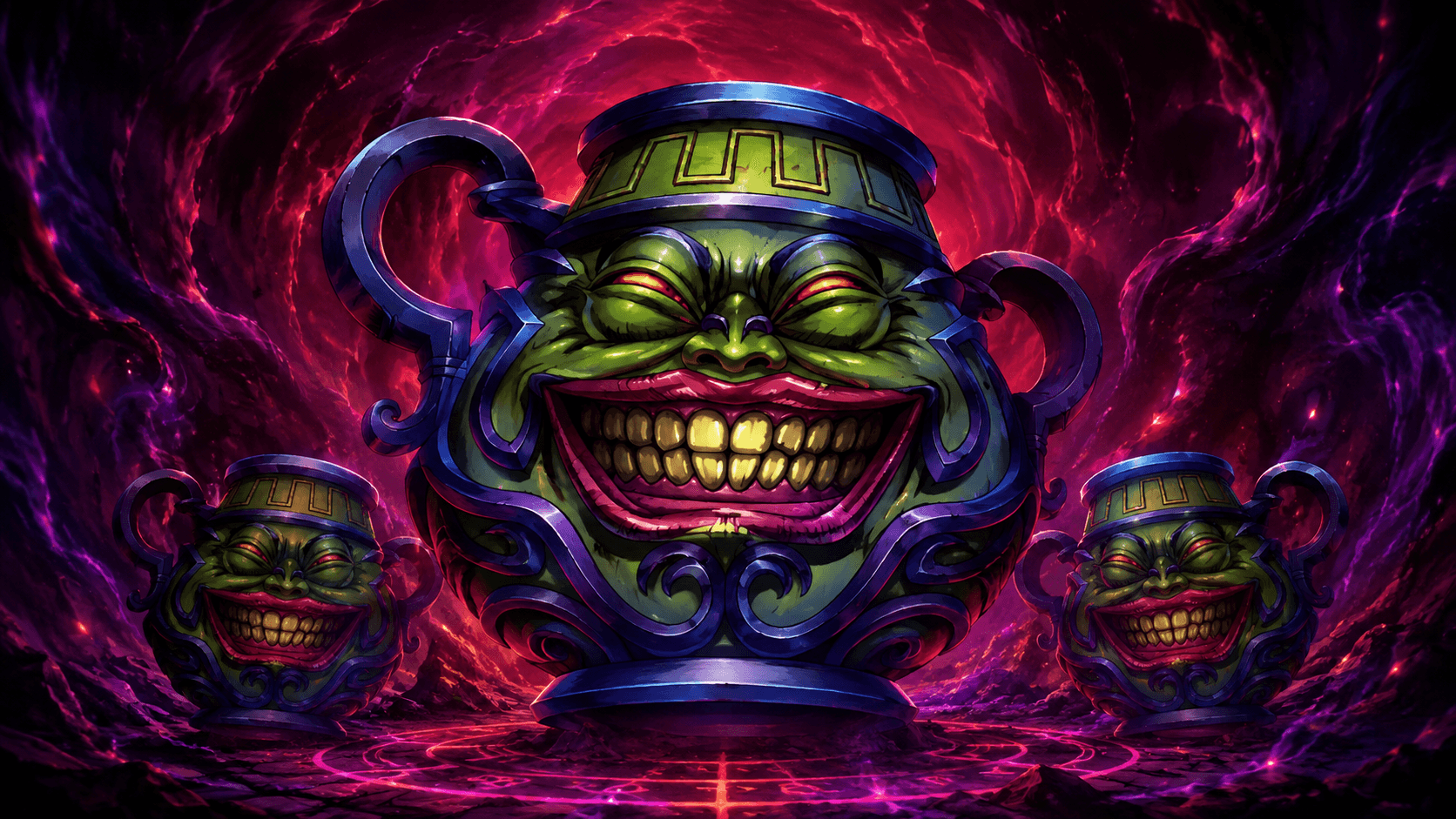
The goat format banlist is not merely a list of cards you cannot play. It is the constitutional document of an entire competitive ecosystem — the invisible architecture that transforms a card pool of over two thousand cards into one of the most balanced metagames Yu-Gi-Oh! has ever produced. Every forbidden card, every restriction to a single copy, every semi-limitation tells a specific story: a strategy that proved too dominant, a combo too explosive for diversity to survive alongside it, or a search engine so efficient that it threatened to make every game feel identical to the last.
Understanding the goat format banlist means understanding why this format works. Not just which cards are restricted, but the philosophy behind each restriction and the chain reactions those restrictions create across every deck, every matchup, and every decision point in the game. This is the document that makes Goat Format possible.
The April 2005 Banlist and Why It Matters
The goat format banlist refers specifically to the Forbidden and Limited List that took effect on April 1, 2005, and remained active until the next update on October 1 of that same year. This six-month window represents the exact regulatory framework under which Goat Format exists. The card pool includes every set released through The Lost Millennium in the TCG, and the banlist is the filter that determines which of those cards can appear in your deck and in what quantity.
What makes this particular banlist remarkable is its position in Yu-Gi-Oh! history. By April 2005, Konami had accumulated several years of competitive data and player feedback. The previous formats had been plagued by degenerate strategies — Yata-Lock making games unwinnable from turn one, Chaos monsters warping every deck-building decision around LIGHT and DARK attributes, and FTK combos turning matches into coin flips. The April 2005 list represents Konami's most surgical intervention up to that point, addressing the worst offenders while leaving enough powerful tools in the format to create genuine strategic diversity.
The result was something nobody fully appreciated at the time: a format where no single deck dominated above forty percent of the metagame, where side-decking actually mattered, and where individual card decisions in deckbuilding created meaningful advantages. The goat format banlist achieved this not through heavy-handed restrictions but through precise, targeted removals that eliminated the most egregious play patterns while preserving the format's strategic richness.
The Forbidden Cards: What Was Too Powerful to Exist
The forbidden section of the goat format banlist reads like a hall of fame for broken card design. Each entry represents a card so fundamentally warping that even a single copy would distort the format beyond recognition. Understanding why these cards earned their place on the forbidden list reveals the design principles that make Goat Format function.
Yata-Garasu stands as perhaps the most infamous card in Yu-Gi-Oh! history, and its presence on the forbidden list is the reason Goat Format can exist as a skill-based competitive environment. This unassuming 200 ATK Spirit monster created the Yata-Lock: once it dealt damage to your opponent, they skipped their next draw phase, and since Yata-Garasu returned to hand at the end of each turn, it could repeat this process indefinitely. Combined with Chaos Emperor Dragon - Envoy of the End, which could wipe both players' hands and fields simultaneously, the Yata-Lock turned games into a two-card inevitability. You did not outplay your opponent — you simply assembled the lock and watched them sit helplessly as their deck became irrelevant. Banning Yata-Garasu removed the single most oppressive win condition in the game's history and restored the fundamental premise that both players should always have a chance to draw answers.
Chaos Emperor Dragon itself earned its forbidden status for similar reasons. A 3000 ATK body that could be summoned by simply banishing one LIGHT and one DARK monster from the graveyard was already above rate, but its effect — paying 1000 life points to send every card on the field and in both hands to the graveyard, dealing 300 damage per card destroyed — turned it into a nuclear option that invalidated entire game states. In a format built around careful resource management and incremental advantage, a card that could erase everything with a single activation had no place.
Fiber Jar represented a different kind of problem. When flipped, it shuffled every card on the field, in both graveyards, and in both hands back into their respective decks, then both players drew five new cards. It essentially reset the entire game to its opening state, nullifying every decision and every advantage built up to that point. In a format that rewards patient, strategic play, a card that could randomly undo ten minutes of careful positioning was antithetical to the format's identity.
Magical Scientist enabled first-turn kill combos that bypassed interaction entirely. By paying life points in increments of 1000, it could special summon Fusion monsters from the Extra Deck, which could then be used as material for further summons or direct damage. Combined with cards like Catapult Turtle, Magical Scientist could deal 8000 damage before the opponent ever took a turn. The goat format banlist exists in part to ensure that games are actually played, and Magical Scientist violated that principle completely.
Makyura the Destructor broke one of the game's fundamental rules: that trap cards must be set for a turn before activation. When sent to the graveyard, Makyura allowed trap cards to be activated directly from the hand for the rest of that turn. This enabled explosive combo turns where cards like Reckless Greed and Temple of the Kings could chain together for massive draw power, fueling FTK strategies that left opponents watching helplessly.
Harpie's Feather Duster and Raigeki both represent one-sided board wipes that violate the format's emphasis on resource parity. Feather Duster destroys all of the opponent's spell and trap cards — every piece of defensive infrastructure, every set Sakuretsu Armor, every face-down Ring of Destruction — for zero cost. Raigeki does the same to monsters. Both cards create such massive swings in board state that they would reduce games to topdecking contests, which is precisely what the goat format banlist is designed to prevent.
Change of Heart takes control of an opponent's monster for a full turn, enabling both its use as an attacker and as tribute fodder. In a format where Airknight Parshath and Thousand-Eyes Restrict already provide powerful swing turns, adding a free monster steal with no cost and no restrictions would push the format past its tipping point. The card is simply too efficient at converting the opponent's resources into your own advantage.
Imperial Order shut down all spell cards on the field for a maintenance cost of 700 life points per turn — a price that aggressive decks would gladly pay to neutralize an opponent's entire spell lineup. In a format where spell cards provide the primary engines of card advantage and board interaction, a single continuous trap that negated all of them simultaneously warped games around its presence in ways that stifled strategic diversity.
Witch of the Black Forest searches for any monster with 1500 or less DEF when sent from the field to the graveyard. Combined with the ability to search critical combo pieces like Sinister Serpent, Magician of Faith, and Sangan-range targets, Witch provided too much consistency and tutoring power. Her presence on the forbidden list ensures that decks cannot rely on multiple search-on-death effects to guarantee finding the exact answer for every situation.
Confiscation costs 1000 life points to reveal the opponent's entire hand and discard one card of choice. The information alone is game-warping — seeing every card your opponent holds lets you plan multiple turns ahead with perfect knowledge. The targeted discard on top removes the opponent's best answer before they can use it. Unlike Delinquent Duo which discards randomly, Confiscation's precision makes it fundamentally more oppressive — you always strip the card that matters most. This combination of perfect information and surgical disruption earned it a place among the forbidden cards.
The Limited Cards: Power Held in Check
The limited section of the goat format banlist represents a more nuanced form of regulation. These are cards powerful enough to shape games around their presence but not so broken that they need to be removed entirely. Limiting them to a single copy per deck means they appear less frequently, creating moments of high impact without dominating every game.
Black Luster Soldier - Envoy of the Beginning is arguably the most powerful card legal in Goat Format. Its summoning condition mirrors the banned Chaos Emperor Dragon — banish one LIGHT and one DARK from the graveyard — but its effects, while devastating, at least allow the opponent to respond. It can either attack twice in a turn or banish a monster it destroys in battle, and it carries 3000 ATK on a body that requires no tribute. BLS wins games the moment it resolves, and its limitation to one copy is the only thing preventing every deck from becoming a vehicle for finding and resolving this single card. The entire deckbuilding tension around LIGHT and DARK monster ratios in Goat Format stems from BLS being legal at one copy — powerful enough to build around, scarce enough that you cannot rely on drawing it.
Tribe-Infecting Virus offers targeted mass removal by discarding a card to destroy all face-up monsters of a declared type. In a format where specific monster types cluster together — Spellcasters in Goat Control, Warriors in Warrior Toolbox — this ability can devastate entire board states. Its limitation ensures that this powerful clearing effect appears as an occasional haymaker rather than a reliable strategy.
Snatch Steal takes permanent control of an opponent's monster in exchange for giving them 1000 life points during each of their standby phases. The life point cost is almost always irrelevant because the stolen monster can be tributed, used for a Metamorphosis fusion, or simply turned into an attacker before the opponent ever benefits from the healing. Limited to one copy, Snatch Steal creates some of the format's most dramatic swing turns — a single card that can reverse a losing position into a winning one.
Breaker the Magical Warrior enters the field with a spell counter that gives it 1900 ATK, and that counter can be removed to destroy a spell or trap card. This dual functionality — a competitively statted monster that doubles as spell and trap removal — makes Breaker one of the most versatile cards in the format. At one copy, it rewards players who time its deployment correctly rather than serving as a generic answer to every situation.
Sangan searches for any monster with 1500 or less ATK when sent from the field to the graveyard. This searcher provides consistency and toolbox access, and its limitation to one copy ensures that decks must make meaningful choices about when and how to use the search effect rather than chaining multiple searches together.
Sinister Serpent returns to its owner's hand during each standby phase as long as it sits in the graveyard. This perpetual recursion provides a discard outlet that never truly costs a card — you can discard Sinister Serpent for Tribe-Infecting Virus, Lightning Vortex, or any other discard cost, then retrieve it next turn. Limited to one, Sinister Serpent is the format's most reliable source of incremental advantage, a quiet engine that smooths out resource management across long games.
Ring of Destruction destroys a face-up monster and deals its ATK as damage to both players. This symmetrical burn effect serves as both removal and a potential finisher, and its ability to destroy your own monsters in response to an opponent's Snatch Steal or Change of Heart effect adds layers of counterplay. At one copy, Ring creates game-ending moments that both players must anticipate and plan around.
Pot of Greed is perhaps the purest form of card advantage ever printed — draw two cards for zero cost. At one copy it remains an automatic inclusion in every deck, but its limitation means each player draws that singular windfall at a different point in the game. The player who resolves Pot of Greed gains a tangible edge, but because it appears only once per forty cards the advantage is a moment rather than a certainty. Meaningful as that edge is, its absence from an opening hand is something every pilot must plan around.
Graceful Charity draws three and discards two. In a format where the graveyard functions as a second hand — Sinister Serpent returns automatically, Magician of Faith recycles spells, and LIGHT/DARK monsters fuel Black Luster Soldier — Graceful Charity often functioned as drawing three cards while simultaneously setting up future plays. Limited to one, it is the single most powerful spell any player can resolve and the card that makes every other draw-engine pale in comparison.
Delinquent Duo attacks the opponent's hand for a mere 1000 life points, discarding one card randomly and forcing the opponent to discard another. Resolving Duo on the opening turn strips two cards when the opponent has only five or six, creating deficits that snowball for the rest of the game. At one copy, the threat of Duo lingers in every matchup — players who suspect it is coming may set cards aggressively to reduce the damage, while the pilot holding Duo must decide the optimal moment to fire it.
Other notable limited cards include Heavy Storm, which destroys all spell and trap cards on the field — unlike the forbidden Harpie's Feather Duster, Heavy Storm hits your own cards too, creating genuine risk-reward decisions about when to activate it. Torrential Tribute destroys all monsters when any monster is summoned, serving as the format's primary mass removal trap. Mirror Force destroys all attacking monsters when an opponent declares an attack, creating the ever-present threat that keeps aggressive players honest. Mystical Space Typhoon provides targeted spell and trap removal at quick-play speed, enabling both proactive removal and reactive chain plays. Each of these cards at one copy contributes to the format's texture without overwhelming it.
The Semi-Limited Cards: Subtle Calibrations
The semi-limited section of the goat format banlist allows two copies per deck, representing the finest calibration available. These cards are powerful enough to warrant some restriction but not so dominant that a single copy is necessary.
Creature Swap forces both players to exchange control of one monster each. At two copies, Creature Swap enables dedicated strategies — particularly in Goat Control, where swapping a Scapegoat token for an opponent's tribute monster creates devastating tempo swings. The semi-limitation acknowledges that Creature Swap is strong but requires setup and can sometimes backfire, making it a skill-testing inclusion rather than an automatic one.
Reinforcement of the Army searches any Level 4 or lower Warrior monster from the deck. This card is the backbone of Warrior Toolbox, enabling access to specific answers like D.D. Warrior Lady, Exiled Force, or Don Zaloog exactly when they are needed. At two copies, ROTA gives Warrior builds enough consistency to compete with the inherent card advantage of Goat Control's engine without making the toolbox so reliable that it eliminates the variance that keeps matchups interesting.
Night Assailant retrieves a Flip Effect monster from the graveyard when discarded, and destroys a face-up monster when flipped. At two copies, it provides recursion for key flip effects like Magician of Faith and Dekoichi the Battlechanted Locomotive while serving as a discard outlet that replaces itself. The semi-limitation prevents excessive looping while preserving the card's role as a utility piece in grind games.
How the Banlist Shapes the Metagame
The true genius of the goat format banlist becomes apparent only when you examine its restrictions as an interconnected system rather than a collection of individual decisions. Every forbidden card removes a degenerate ceiling. Every limited card creates a scarce resource that players must manage carefully. Every semi-limitation fine-tunes the balance between consistency and variance. Together, these restrictions create the conditions for Goat Format's legendary equilibrium.
Consider the chain reaction that begins with limiting Pot of Greed and Graceful Charity to a single copy each. Because these universal draw spells appear only once per deck, players cannot rely on raw card advantage to outpace opponents — every individual card becomes more precious, which in turn makes Dekoichi the Battlechanted Locomotive and Magician of Faith critical as slower, interactive sources of card advantage. Those flip effect monsters are vulnerable to Nobleman of Crossout, which creates demand for chainable protection like Book of Moon. Book of Moon doubles as offensive disruption, which increases the value of monsters with strong flip effects, which circles back to the importance of card advantage in a format where draw power is scarce and precious.
This kind of self-reinforcing strategic loop exists throughout the format, and every loop traces back to a specific banlist decision. Black Luster Soldier being limited to one creates the LIGHT/DARK tension that influences every monster choice. Scapegoat into Metamorphosis into Thousand-Eyes Restrict is the format's signature combo — both cards are unrestricted, making the engine highly consistent and central to how the format plays. Heavy Storm at one forces players to choose between committing multiple backrow cards for protection and playing conservatively to avoid getting blown out.
The format's health depends on these interlocking restrictions maintaining their delicate balance. If any single card moved from forbidden to limited, or from limited to unlimited, the ripple effects would cascade through the entire ecosystem. This is why the Goat Format community treats the April 2005 banlist as sacred text — not out of nostalgia, but because twenty years of competitive play have demonstrated that this specific configuration produces consistently excellent games.
When you understand why Pot of Greed and Graceful Charity at one copy reshape every game without overwhelming the format, when you grasp why Snatch Steal at one creates exciting moments while at three it would be oppressive, when you recognise that Reinforcement of the Army at two is the precise number that makes Warrior Toolbox competitive without making it dominant — then you have understood not just the banlist, but the format itself.
On GoatWorld you can explore the complete interactive banlist, with every card clickable and filterable by status. Alongside the banlist, our card pool database lets you browse every legal card in the format, build decks, and verify the legality of your lists. The goat format banlist is not an obstacle — it is the blueprint that makes one of the greatest formats ever created possible.
Keep Reading
Deepen your Goat Format knowledge:
- What Is Goat Format? — History, mechanics, and why the format endures
- Goat Format Tier List 2026 — Every deck ranked with matchup analysis
- Goat Format Rules — Priority system, chain resolution, and damage step
- Goat Format Staples — Every must-have card explained
- Goat Control Deck Guide — The format's signature deck dissected
- Where to Play Online — Every platform compared
- Yu-Gi-Oh! Retro Formats Guide — Every retro format compared: Goat, Edison, HAT, Tengu and more
- Global Rankings — Track the best players in the Goat World community
Build your deck and prove yourself. Join the Goat World Discord — register in minutes, play for free.