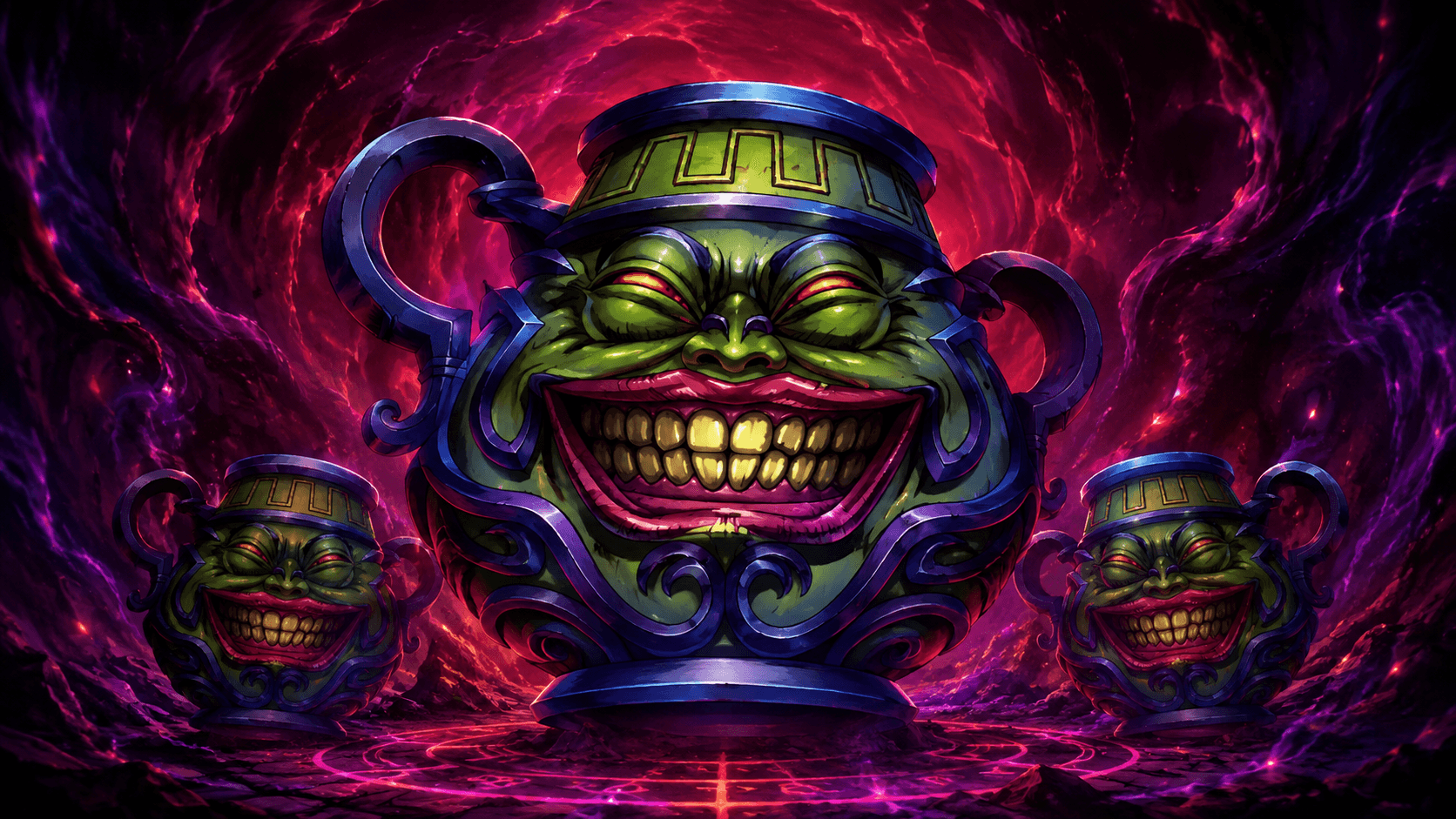
If you've spent any time around the Yu-Gi-Oh! community — whether browsing Reddit threads, lurking in Discord servers, or watching old tournament footage on YouTube — you've almost certainly encountered the term "Goat Format." It's spoken with a kind of reverence that few other topics in the trading card game world receive. Veterans call it "the golden age." Newer players hear about it and wonder what all the fuss is about. And somewhere in between, a thriving global community keeps playing, theorycrafting, and debating the same card pool that defined competitive Yu-Gi-Oh! over two decades ago.
So what exactly is Goat Format, and why does a format frozen in 2005 continue to draw thousands of active players in 2026? The answer goes deeper than nostalgia. It touches on game design, competitive integrity, and a philosophy about what makes a card game genuinely fun to play.
The Format That Stopped the Clock
Goat Format refers to a specific snapshot of the Yu-Gi-Oh! Trading Card Game as it existed during the spring and summer of 2005. More precisely, it uses the April 2005 Forbidden and Limited List alongside every card that was legally available in the TCG up through the release of The Lost Millennium (TLM), the last major set before the August 2005 banlist shook everything up. Some communities also include Cybernetic Revolution (CRV) in their card pool, though the most widely accepted standard stops at TLM.
What makes this particular window so special? It sits at a remarkable sweet spot in Yu-Gi-Oh!'s history. The game had evolved far enough beyond its earliest days — when whoever drew Raigeki or Harpie's Feather Duster first usually won — to develop real strategic depth. Powerful cards existed, certainly, but no single strategy was so dominant that it choked out everything else. The metagame was diverse, the power level was high but manageable, and individual card advantage decisions mattered enormously. It was, in many players' estimation, the moment where Yu-Gi-Oh! achieved perfect balance between simplicity and complexity.
The name itself comes from the card Scapegoat, a Quick-Play Spell that summons four 0/0 Sheep Tokens. In the 2005 metagame, Scapegoat was everywhere — it served as defensive fodder, tribute material for Airknight Parshath or Metamorphosis into Thousand-Eyes Restrict, and a key piece of the most iconic deck of the era: Goat Control. The card was so central to the format's identity that the entire era became synonymous with it.
Why 2005 and Not Any Other Year
To understand why Goat Format occupies such a special place, it helps to know what came before and after. In the earliest years of Yu-Gi-Oh!, the game was defined by raw power. Cards like Dark Hole, Raigeki, and Change of Heart created enormous swings with zero counterplay. Whoever opened the most broken cards won, and skill was often a secondary factor. The game was fun in a chaotic way, but it wasn't particularly deep.
By 2004 and into early 2005, Konami had refined the banlist enough to remove or restrict the most egregious offenders while leaving a rich ecosystem of powerful-but-fair cards intact. Pot of Greed and Graceful Charity were still legal, which kept the game fast and exciting. Black Luster Soldier - Envoy of the Beginning provided a terrifying boss monster that demanded respect but could be answered. Breaker the Magical Warrior, Tribe-Infecting Virus, and Airknight Parshath gave aggressive strategies real teeth. And defensive tools like Sakuretsu Armor, Torrential Tribute, and Mirror Force meant that overextending was punished severely.
Then came August 2005, and everything changed. The new banlist hit hard, removing many of the format's defining cards and ushering in a completely different metagame. What followed — Chaos Return, Monarch formats, and eventually the Synchro and XYZ eras — took Yu-Gi-Oh! in directions that many players found increasingly alienating. The game got faster, more combo-oriented, and more expensive. For a large segment of the player base, something was lost.
Goat Format preserves the moment right before that shift. It's not just nostalgia for 2005 — it's appreciation for a style of gameplay that the modern game has largely abandoned.

The Card Pool: What You Can and Cannot Play
The Goat Format card pool encompasses every TCG-legal card released from the game's launch through The Lost Millennium in June 2005. In practical terms, this means you have access to cards from Legend of Blue Eyes White Dragon all the way through TLM, including all Structure Decks, tins, and promotional releases from that period.
This sounds like a lot of cards, and it is — but the playable portion is much smaller than you might expect. Because the format has been analyzed and refined for over twenty years, the community has developed a deep understanding of which cards actually matter. The vast majority of sets from that era contain cards that are simply too weak or too niche to see competitive play. What you're left with is a curated pool of perhaps 150–200 genuinely viable cards, which creates an environment where deckbuilding is about making tight, meaningful choices rather than sifting through thousands of options.
The banlist itself is the April 2005 Forbidden and Limited List, which restricts the format's most powerful cards to keep the metagame healthy. Cards like Raigeki, Harpie's Feather Duster, and Yata-Garasu are completely forbidden. Format staples like Black Luster Soldier - Envoy of the Beginning, Sinister Serpent, Pot of Greed, and Graceful Charity are limited to one copy. And a handful of strong-but-not-broken cards sit on the semi-limited list at two copies. This restriction framework is what gives the format its distinctive texture — you have access to incredibly powerful effects, but only in carefully measured doses.
One important note for newer players: the card pool does not include any Synchro, XYZ, Pendulum, or Link monsters. The Extra Deck (called the Fusion Deck in 2005) contains only Fusion monsters, and accessing them requires specific Fusion Spells like Polymerization or, far more commonly, Metamorphosis. This single mechanical difference fundamentally changes how the game feels. There are no explosive combo turns that end on multiple negations. Boards are built incrementally, one card at a time, and dismantled the same way.
The Decks That Define the Format
One of Goat Format's greatest strengths is its metagame diversity. While certain decks are undeniably stronger than others, the gap between tiers is narrow enough that skilled pilots can find success with a wide range of strategies. The format rewards mastery of a chosen deck far more than it rewards simply picking the "best" option.
At the top of the competitive hierarchy sits Goat Control, the deck that gave the format its name. Goat Control is a midrange strategy built around generating card advantage through cards like Pot of Greed, Graceful Charity, Delinquent Duo, and Airknight Parshath, then using defensive tools like Scapegoat, Book of Moon, and Thousand-Eyes Restrict to grind opponents out of resources. It's the most skill-intensive deck in the format — every card in the deck interacts with every other card in complex ways, and the decision trees are enormous. Two players can run identical Goat Control lists and produce wildly different results based purely on how they sequence their plays.
Chaos Control takes a more aggressive approach, leveraging the raw power of Black Luster Soldier - Envoy of the Beginning and Chaos Sorcerer alongside LIGHT and DARK monsters that fuel their summoning conditions. Where Goat Control grinds, Chaos Control threatens to end games suddenly with its banishing effects and massive attack values. The deck trades some consistency for explosive potential, and in the hands of a player who understands when to shift gears between aggression and patience, it's devastatingly effective.
Warrior Toolbox exploits Reinforcement of the Army to search a lineup of situationally powerful warriors — D.D. Warrior Lady, Exiled Force, Mystic Swordsman LV2, and others — giving it remarkable flexibility in answering whatever the opponent presents. It's a deck that rewards format knowledge above all else, because choosing the right warrior for each situation is what separates good Warrior Toolbox players from great ones.
Beyond these Tier 1 contenders, the format supports a rich ecosystem of competitive strategies. Zoo (or Beastdown) overwhelms opponents with efficient beaters like Berserk Gorilla and Enraged Battle Ox. Reasoning Turbo uses Reasoning and Monster Gate to cheat powerful monsters into play at breakneck speed. Burn and Stall decks exploit the format's relatively slow pace to win through direct damage or deckout. Empty Jar attempts to mill the opponent's entire deck in a single turn using Cyber Jar and Book of Taiyou. Each of these strategies has real competitive viability, and part of what makes Goat Format so endlessly replayable is learning how each matchup plays out and adapting your strategy accordingly.
Rules That Change Everything
Goat Format doesn't just use a different card pool — it operates under a different set of rules than modern Yu-Gi-Oh!, and these mechanical differences have profound implications for gameplay.
The most significant is Ignition Effect Priority. Under 2005 rules, when you successfully Normal Summon or Flip Summon a monster, you have the right to activate that monster's Ignition Effect before your opponent can respond with a card like Torrential Tribute or Bottomless Trap Hole. This means that summoning Breaker the Magical Warrior guarantees you the chance to use his spell counter to destroy a Spell or Trap card, even if your opponent has removal set. It means Tribe-Infecting Virus can declare a type and wipe the board before being destroyed. This rule adds an entire layer of strategic consideration that doesn't exist in the modern game — both for the player summoning and the player trying to respond.
The Extra Deck is a Fusion Deck in every sense. It holds a maximum of 15 cards, all of which must be Fusion monsters. The most important occupant by far is Thousand-Eyes Restrict, accessed almost exclusively through Metamorphosis on a Level 1 monster (usually a Sheep Token from Scapegoat). This interaction — Scapegoat into Metamorphosis into Thousand-Eyes Restrict — is the format's most iconic play and one of the first things every new Goat Format player learns.
Last Turn and other older cards function under their original rulings, and certain interactions work differently than modern players might expect. Ring of Destruction can end the game in a draw. Sinister Serpent returns to your hand every Standby Phase, providing a perpetual resource engine. These quirks aren't bugs — they're features that give the format its distinctive character.
Match structure follows standard best-of-three with a 15-card Side Deck, and standard tournament time rules apply. The format is played exclusively in Advanced Format (not Traditional), meaning Forbidden cards are truly forbidden, not merely limited to one copy.
Why Goat Format Thrives in 2026
The obvious explanation is nostalgia, and there's certainly truth to that. Many Goat Format players are adults who grew up with the game in the early 2000s and find genuine joy in returning to the cards they remember. But nostalgia alone doesn't sustain a community for over two decades. Plenty of old formats are remembered fondly without anyone actually playing them. Goat Format endures because it offers something that the modern game struggles to provide.
The first and most frequently cited reason is skill expression. In a format where games regularly last fifteen or twenty turns, where neither player has access to unbreakable boards or one-turn-kill combos, every single decision accumulates. Setting the wrong trap, attacking into the wrong monster, or using Pot of Greed at the wrong moment can cost you a game — not immediately, but six or seven turns later when the card advantage deficit finally catches up. This slow-burning, chess-like quality appeals to players who want their wins to feel earned and their losses to feel educational.
The second reason is accessibility. Building a competitive Goat Format deck costs a fraction of what a modern Yu-Gi-Oh! deck demands. Because the card pool is fixed and the format is community-driven rather than officially supported by Konami, there's no rotation, no power creep, and no pressure to buy the latest product. A complete Goat Control deck can be assembled for under $50 in physical cards, and online platforms like GoatWorld let you play with the full card pool for free. The barrier to entry is essentially zero.
There's also the matter of game length and pacing. Modern Yu-Gi-Oh! games frequently end on turn one or two, with one player assembling an insurmountable board before the opponent gets to play. Goat Format games are back-and-forth exchanges that develop over many turns, with momentum shifting multiple times before a winner emerges. For players who enjoy the social, interactive aspect of card games — the bluffing, the reading, the gradual outmaneuvering — this pacing is infinitely more satisfying.
Finally, there's the community itself. Goat Format has cultivated one of the most passionate and welcoming communities in all of competitive gaming. Because the format is entirely player-run, the people who maintain it do so out of genuine love for the game. Tournament organizers, content creators, database maintainers, and platform developers all contribute their time and energy to keep the format alive. It's a labor of love, and that spirit is palpable the moment you join a Goat Format Discord server or enter your first online tournament.
How to Start Playing Today
Getting into Goat Format has never been easier. The format's community has built robust infrastructure for online play, and you don't need to own a single physical card to get started.
The most direct path is through GoatWorld, a dedicated platform built specifically for Goat Format play. GoatWorld provides a complete card database with every legal card in the format, deckbuilding tools that enforce the correct banlist automatically, and a matchmaking system that connects you with opponents at your skill level. You can browse the full card pool, study the banlist, and build your first deck all in one place.
If you're not sure where to begin with deckbuilding, the community consensus is clear: start with Goat Control. It's the format's flagship deck for a reason — it teaches you the fundamental skills that every Goat Format player needs, from resource management to reading your opponent's backrow. The deck is challenging to master, which means you'll always have room to improve, and the lessons you learn piloting Goat Control transfer directly to every other deck in the format.
Once you've built your deck, jump into games. The learning curve is real but rewarding. Your first few matches will likely be confusing — the format has depth that isn't immediately apparent, and experienced players will punish mistakes you didn't even know you were making. That's part of the appeal. Every loss teaches you something, every win feels earned, and the format reveals new layers of complexity the more you play.
For community support, the GoatWorld Discord server is the hub of all activity. You'll find deck discussions, ruling questions answered in real time, tournament announcements, and a welcoming community of players ranging from complete beginners to format veterans with years of experience. Whether you played in 2005 and want to relive the golden age or you've never touched a Yu-Gi-Oh! card in your life, there's a place for you at the table.
Goat Format has endured for over twenty years because it represents something rare in competitive gaming: a format where skill matters more than money, where games are decided by decisions rather than dice rolls, and where the community that sustains it does so out of genuine passion. Come see what all the fuss is about.
Keep Reading
Now that you know what Goat Format is, dive deeper:
- Goat Format Tier List 2026 — Every competitive deck ranked and explained
- Goat Format Banlist Explained — Why every card is forbidden, limited, or semi-limited
- Goat Format Rules — Priority, damage step, and every 2005 mechanic explained
- Goat Format Staples — Every must-have card explained
- Goat Control Deck Guide — The format's signature deck dissected
- Where to Play Online — Every platform compared for 2026
- Yu-Gi-Oh! Retro Formats Guide — Every retro format compared: Goat, Edison, HAT, Tengu and more
- Global Rankings — See who's at the top of the Goat World leaderboard
Ready to play? Join the Goat World Discord — it's free, and your first ladder match is one command away.