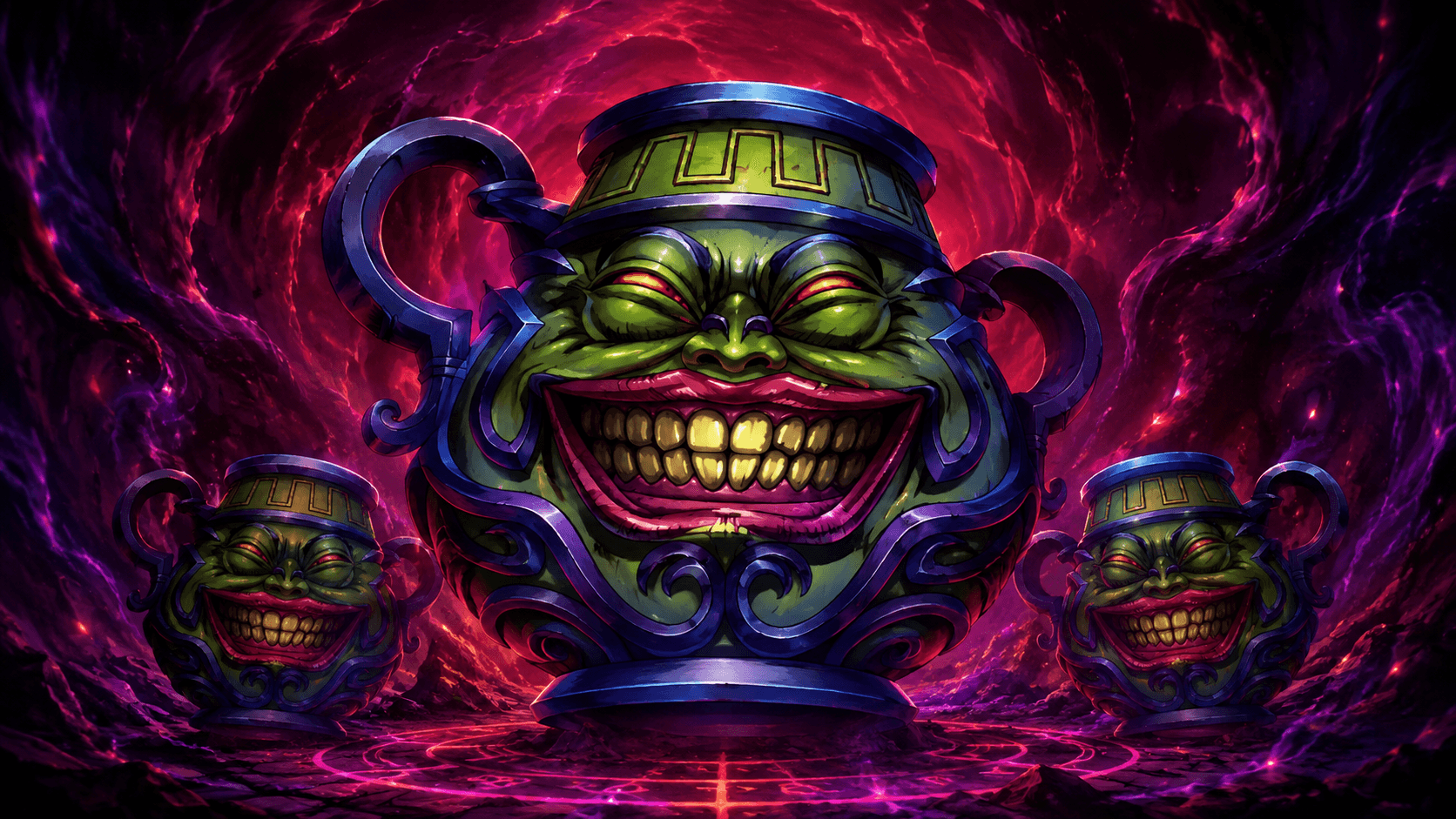
Yu-Gi-Oh! retro formats are community-curated competitive environments that freeze the card pool and banlist at a specific moment in the game's history. Instead of spending hundreds of dollars chasing the latest booster set, you build a deck from a fixed library of cards, play under rules that never change, and compete in a metagame that evolves through player innovation alone. For thousands of players worldwide, retro formats represent the purest and most rewarding way to experience competitive Yu-Gi-Oh! — and the movement grows larger every year.
This guide covers every major yugioh retro format from the 2002 Chaos era through the 2014 HAT metagame. Whether you are a returning player who remembers setting Mirror Force in 2005, a modern player curious about what older Yu-Gi-Oh! feels like, or someone researching which retro format to try first, this article gives you everything you need to make an informed choice. We compare every format's speed, complexity, cost, and community size so you can find the one that fits the way you want to play.
What Are Retro Formats in Yu-Gi-Oh?
A yugioh retro format is any competitive format that uses a historical card pool and banlist rather than the current one. The concept is straightforward: pick a moment in Yu-Gi-Oh! history, lock the available cards to everything released up to that point, apply the Forbidden and Limited list active during that window, and play under the Master Rules that governed the game at the time. The result is a self-contained competitive environment where new product releases have zero impact on deckbuilding, pricing, or strategy.
The retro format movement started informally around 2012 when players in online communities began organizing tournaments using the April 2005 banlist — what would eventually become known as Goat Format. The idea spread because it addressed the two biggest complaints about modern Yu-Gi-Oh!: escalating costs and power creep that made older cards obsolete. In a retro format, your deck never rotates out, your cards never get power-crept, and the entry cost stays fixed because no new must-have releases ever appear.
How Retro Formats Work
Every yugioh retro format is defined by three attributes: a card pool cutoff (which sets are legal), a Forbidden and Limited list (which cards are restricted), and a ruleset (which version of the Master Rules applies). Goat Format, for example, uses every set through The Lost Millennium, the April 2005 F&L list, and the Master Rules as understood in mid-2005 — including the priority system that allows ignition effects on summon, the first-turn draw rule, and 2005-era damage step timing. These parameters create a complete, self-contained game that can be played identically today as it was played twenty years ago.
Some retro formats also use unofficial supplementary rules adopted by community consensus. The most notable example is Edison Format's "Time Travel" variant, which applies modern Master Rules (no priority on summon, Problem-Solving Card Text updates) to the March 2010 card pool and banlist. These variants exist because different communities prefer different rule interpretations, and the decentralized nature of retro formats means there is no single governing authority — communities self-organize around the version they enjoy most.
Are Retro Formats Official?
Retro formats are not sanctioned by Konami for official tournament play. The Official Card Game and Trading Card Game operate under a single rotating banlist and ruleset, and all sanctioned events use the current format. However, Konami has acknowledged the community interest in historical play through its "Time Wizard" tournament format, which allows stores to run events using older banlists. Konami has also released Speed Duel products that reprint classic cards specifically because retro format demand drives secondary market prices.
In practical terms, the distinction between "official" and "community" is irrelevant to most retro format players. The communities are self-sustaining, with their own tournament circuits, ranking systems, Discord servers, and dedicated platforms. GoatWorld alone runs a full ranked ladder, seasonal championships, and league play for Goat Format, replicating every feature a sanctioned environment would provide — minus the official Konami stamp.
Why Retro Formats Are Growing in Popularity
The surge in retro format popularity has three drivers. First, modern Yu-Gi-Oh! has become prohibitively expensive for casual and returning players. A competitive modern deck can cost three hundred to five hundred dollars and lose viability within a single banlist update. A retro format deck costs thirty to one hundred dollars and stays competitive forever — five tournament-ready Goat Format decks can be built for under thirty dollars each.
Second, retro formats reward different skills than the modern game. Modern Yu-Gi-Oh! emphasizes combo memorization, resource sequencing through long turns that can last five minutes or more, and knowledge of hundreds of negation effects. Retro formats emphasize resource management, bluffing, side-decking, and reading your opponent — skills that appeal to players who prefer poker-like decision-making over solitaire-like execution.
Third, nostalgia is a genuine and powerful force. Many players who grew up watching the anime in the early 2000s left the game during the Synchro or XYZ era and now discover that the formats they remember are alive and thriving online. For these returning players, retro formats provide a welcoming on-ramp that leverages the cards and strategies they already know.
The Retro Format Timeline
Yu-Gi-Oh! retro formats span over a decade of competitive history. Each format is named after either a defining card, a defining mechanic, or the set that was most recently released when the format existed. Understanding where each format sits in the game's timeline helps explain the differences in speed, complexity, and design philosophy.
The earliest recognized retro format is the 2002-2004 Chaos era, dominated by cards like Chaos Emperor Dragon - Envoy of the End and Yata-Garasu. This is followed by Goat Format in April 2005, often called the golden age. Reaper Format (October 2005) and the various 2006-2007 formats bridge the gap to TeleDAD Format in September 2008, where the pace of the game began to accelerate significantly. Edison Format arrives in March 2010 with the first Synchro-era retro environment. Tengu Plant Format (September 2011) introduces even more Synchro complexity, Wind-Up Format (September 2012) adds XYZ Monsters, and HAT Format (April 2014) sits at the intersection of XYZ and early Pendulum design — the last widely played retro format before card design entered its modern era.
Each successive format in this timeline moves a step faster, adds a layer of complexity, and expands the card pool. A player who starts with Goat Format and works forward through the timeline is essentially playing through the evolution of Yu-Gi-Oh! card design in real time.
Goat Format (April 2005) — The Original
Goat Format is the most popular yugioh retro format by a significant margin and the one that started the entire retro movement. Named after Scapegoat, the card whose interaction with Metamorphosis and Thousand-Eyes Restrict defines the format's most iconic play pattern, Goat Format uses the April 2005 Forbidden and Limited list and every set through The Lost Millennium.
What Makes Goat Format Special
The defining characteristic of Goat Format is its pace. Games routinely last fifteen to twenty-five turns, with both players setting face-down monsters, managing limited resources, and jockeying for incremental advantages through flip effects like Magician of Faith, Dekoichi the Battlechanted Locomotive, and Morphing Jar. There are no infinite combo loops, no unbreakable boards, and no turns that last five minutes. Every decision matters because recovery from a mistake is possible but costly.
The priority system adds a layer that modern Yu-Gi-Oh! has removed: when you Normal Summon a monster, you have priority to activate its ignition effect before the opponent can respond with traps like Torrential Tribute. This means summoning Tribe-Infecting Virus and immediately activating its effect to clear the board is a legal and common play, adding a dimension of interaction that newer players find refreshing.
Top Decks in Goat Format
The Goat Format tier list features remarkable diversity. Goat Control is the format's defining deck, built around Scapegoat, Metamorphosis, and an engine of flip-effect monsters that grind out card advantage. Chaos variants leverage Black Luster Soldier - Envoy of the Beginning as a game-ending finisher. Warrior Toolbox uses Reinforcement of the Army to search situational answers. Burn decks ignore the battle phase entirely and win through direct damage. No single archetype dominates more than forty percent of the metagame — a balance unmatched in any era of competitive Yu-Gi-Oh!.
Community Size and Activity
Goat Format has the largest and most active retro format community. GoatWorld operates a full ranked ladder with Elo-based matchmaking, seasonal rankings, and regular tournament coverage. DuelingBook, EDOPro, and Dueling Nexus all support Goat Format with dedicated banlists. Multiple Discord servers with thousands of members run weekly tournaments, and GoatWorld's Discord alone has become the central hub for competitive Goat Format play.
Edison Format (March 2010) — The Rising Star
Edison Format is the second most popular yugioh retro format and the fastest-growing. Named after the Edison, New Jersey Shonen Jump Championship held in March 2010, this format uses the March 2010 Forbidden and Limited list and introduces the game's first major mechanical evolution: Synchro Summoning.
What Makes Edison Format Unique
Edison Format sits at the sweet spot where Yu-Gi-Oh!'s Extra Deck mechanics were powerful enough to add strategic depth but not yet dominant enough to make the game feel like a race to establish an unbreakable board. Synchro Monsters like Brionac, Dragon of the Ice Barrier, Goyo Guardian, and Stardust Dragon provide powerful toolbox options that reward sequencing and timing, but the format still has meaningful back-and-forth interaction and games that last beyond the first three turns.
The card pool is roughly three times the size of Goat Format's, which means more deck diversity but also a steeper learning curve. Where Goat Format has perhaps ten competitive archetypes, Edison Format has over twenty — including Blackwing, Lightsworn, Gladiator Beast, Frog Monarch, Infernity, X-Saber, Machina Gadget, and numerous rogue strategies.
Top Decks in Edison Format
The Edison metagame is defined by its breadth. Quickdraw Dandywarrior combines Quickdraw Synchron with Dandylion for explosive Synchro plays. Blackwing decks swarm the field with DARK Winged-Beast monsters and apply relentless pressure. Lightsworn mills aggressively to fuel Judgment Dragon's board-clearing effect. Gladiator Beast decks answer threats through contact fusion after battle. Frog Monarch controls the game through tribute monsters backed by the recursive Treeborn Frog. This diversity means matchup knowledge is critical and no single sideboard plan covers everything.
Community Size and Activity
Edison Format's community has grown dramatically since 2023. edisonformat.com serves as the format's primary resource hub, with banlist documentation, deck databases, and tournament information. DuelingBook and EDOPro both support Edison, and dedicated Discord servers host regular tournaments. The format appeals particularly to players who enjoy Synchro-era mechanics but want a slower, more interactive version of them than what modern Yu-Gi-Oh! offers.
Tengu Plant Format (September 2011)
Tengu Plant Format takes its name from Reborn Tengu, a monster that replaces itself when removed from the field and enabled a generation of Plant-engine Synchro decks. This format uses the September 2011 banlist and a card pool that extends through Generation Force, placing it firmly in the Synchro/XYZ transition era.
What Defines Tengu Format
Tengu Plant format is faster than Edison but still interactive. The Plant engine — Lonefire Blossom into Dandylion or Spore — generates tokens and tuners that fuel Synchro chains, while Reborn Tengu provides a stream of free bodies that keep your field alive through interruption. The format also marks the debut of Rank 4 XYZ Monsters, though their impact is minor compared to the Synchro toolbox.
The metagame is dominated by Agent/Venus builds, which use Master Hyperion and The Agent of Mystery - Earth alongside the Tengu engine. Dark World decks exploit Grapha, Dragon Lord of Dark World, and various Synchro-spam strategies compete for tier 1 status. The format is rewarding for players who enjoy complex sequencing and resource management through Extended Deck mechanics.
HAT Format (April 2014) — The Modern Classic
HAT Format is named after the three decks that defined its metagame: Hand (Fire Hand + Ice Hand), Artifacts, and Traptrix. This format uses the April 2014 banlist and a card pool that extends through Primal Origin, representing the most "modern-feeling" retro format that a significant community has adopted.
What Is HAT Format?
HAT Format sits at the intersection of XYZ-era Yu-Gi-Oh! and early Pendulum design. The Extra Deck is central to every strategy, Rank 4 XYZ Monsters like Evilswarm Exciton Knight and Number 101: Silent Honor ARK provide powerful generic tools, and trap cards still matter — unlike later formats where spell-speed-2 monster negation made traditional traps obsolete.
The Hand monsters (Fire Hand and Ice Hand) create a unique dynamic: when destroyed by battle, they destroy one of the opponent's cards and replace themselves with the other Hand. This means attacking into an unknown face-down monster carries genuine risk, creating a layer of bluffing reminiscent of Goat Format's face-down game. Artifact monsters special summon themselves when your set spell/trap cards are destroyed, punishing blind removal. Traptrix monsters search bottomless Trap Hole variants, adding consistency to the trap lineup.
Why HAT Is Gaining Popularity
HAT Format appeals to players who want a retro experience that still feels modern. The Extra Deck is diverse and impactful, combos exist but are short and interactive, and the sideboard significantly shapes matchups. The format also benefits from relatively affordable card prices — most HAT staples were widely printed and remain accessible. For players transitioning from modern Yu-Gi-Oh!, HAT Format is the easiest retro format to learn because its mechanics (XYZ, Trap Holes, chain interactions) are closest to the current game.
Other Notable Retro Formats
Beyond the five major retro formats above, several historical periods have dedicated communities.
Reaper Format (October 2005)
Reaper Format uses the October 2005 banlist, immediately following the Goat Format window. The most significant change is the limitation of Thousand-Eyes Restrict, which removes the Scapegoat-Metamorphosis engine and shifts the metagame toward more aggressive strategies. Chaos Return and Warrior builds become dominant without TER to lock the board. Reaper Format appeals to Goat Format players who want a slightly faster, more combat-oriented variation of the same era.
TeleDAD Format (September 2008)
TeleDAD Format is named after the combination of Emergency Teleport and Dark Armed Dragon, two cards that defined competitive Yu-Gi-Oh! in the fall of 2008. This was the era of Tele-DAD Synchro decks that could establish dominant board states by turn two, punishing opponents who could not respond immediately. TeleDAD Format is significantly faster than Goat or Edison and appeals to players who enjoy explosive, high-stakes gameplay.
Chaos/Treasure Format (2002-2004)
The earliest era of competitive Yu-Gi-Oh!, dominated by Chaos Emperor Dragon, Yata-Garasu, and later by Black Luster Soldier - Envoy of the Beginning at three copies. This format is historically significant but rarely played competitively because its game design is fundamentally degenerate — FTK combos with Magical Scientist, the Yata-Lock, and Chaos Emperor Dragon one-sided board wipes reduce many games to coin flips. Most players interested in early Yu-Gi-Oh! history start with Goat Format instead.
Retro Formats Compared: Which Should You Play?
Choosing a yugioh retro format depends on what you value most in competitive play. Below is a comparison based on five factors: game speed, strategic complexity, entry cost, community size, and online accessibility.
Goat Format is the slowest and most cerebral format on this list. Games last twenty turns or more, the card pool is the smallest, and every decision carries weight because recovery from mistakes is measured in turns, not cards. Entry cost is the lowest — thirty to eighty dollars for a physical deck, free on every major online simulator. Community size is the largest, and online play is available around the clock through GoatWorld and DuelingBook.
Edison Format is medium-paced with a larger card pool that rewards format-specific knowledge. Synchro Monsters add a toolbox layer that Goat Format lacks, and the metagame is broader with over twenty viable archetypes. Entry cost is moderate — forty to one hundred dollars physically. The community is the second-largest and growing fast, with strong online support on DuelingBook and EDOPro.
Tengu Plant Format is faster than Edison with a higher skill ceiling for sequencing complex Synchro chains. The community is smaller, concentrated on DuelingBook and Discord. Entry cost is sixty to one hundred and fifty dollars physically — some key Synchro staples command sustained prices.
HAT Format is the most "modern-feeling" retro format, with XYZ mechanics, trap-heavy gameplay, and diverse Extra Deck options. It appeals to current-era players who want a retro experience without abandoning modern design sensibilities. Community size is moderate and growing. Entry cost is fifty to one hundred twenty dollars.
Best Retro Format for Beginners
If you are new to retro Yu-Gi-Oh! formats, start with Goat Format. The card pool is small enough to learn in a weekend, the game pace gives you time to read cards and think through decisions, the community is large enough that you will always find opponents, and you can play entirely for free online. Once you are comfortable with Goat Format fundamentals — resource management, bluffing with face-downs, graveyard interaction — you can branch into Edison Format for a more complex experience or HAT Format if you prefer XYZ-era mechanics.
Best for Competitive Players
Players who want the deepest competitive experience should consider Edison Format or Goat Format. Both have large enough communities to support regular tournaments, both have well-developed metagames with extensive strategic literature, and both reward the kind of long-term study and matchup preparation that competitive players enjoy. Edison edges ahead for players who want more mechanical complexity; Goat Format wins for players who value game theory and psychological warfare.
Cheapest Retro Format to Build
Goat Format is the cheapest retro format to enter by a significant margin. Budget competitive decks can be built for fifteen to thirty dollars, and even the most expensive builds (Goat Control with original printings of staple cards) rarely exceed eighty dollars. Edison Format is the next cheapest, followed by HAT Format and Tengu Plant in ascending order. All retro formats are dramatically cheaper than modern competitive Yu-Gi-Oh!, which routinely requires two hundred to five hundred dollars per format cycle.
Largest Community
The retro format community hierarchy by size is: Goat Format (largest), Edison Format (second), HAT Format (third), Tengu Plant (fourth). For specific community hubs:
Goat Format players gather primarily on GoatWorld's Discord and DuelingBook. The GoatWorld platform itself provides ranked play, tournament coverage, and global rankings. Edison Format players converge on edisonformat.com and multiple Discord servers. HAT and Tengu communities are primarily Discord-based with smaller but passionate player pools.
Where to Play Retro Formats Online
Every major yugioh retro format can be played online for free. Our dedicated guide on where to play Goat Format online covers the full platform landscape, but here is a summary relevant to retro format players across all eras.
GoatWorld is the premier platform for competitive Goat Format, offering ranked ladder play with Elo-based matchmaking, seasonal leagues, Sit-n-Go tournaments, and global rankings. Registration is free and takes minutes through the GoatWorld Discord.
DuelingBook supports every retro format through its manual card simulator. Players can select any historical banlist and play under any ruleset. It is the most versatile platform for retro format play but requires both players to manually enforce card effects and rules. DuelingBook is browser-based and free.
EDOPro (Project Ignis) automates card effects and supports every retro format through custom banlist selection. It is the best option for players who want automated enforcement of complex card interactions, especially in Edison and later formats where Synchro/XYZ chains can be mechanically dense. EDOPro is downloadable and free.
Dueling Nexus offers browser-based automated play with retro format support. It is the most accessible option for players who want to start playing immediately without installing software.
How to Get Started with Retro Yu-Gi-Oh!
Getting into retro Yu-Gi-Oh! formats takes less than thirty minutes and costs nothing. The process is the same regardless of which format you choose.
Pick a format that matches your interests. If you want the largest community with the slowest, most strategic gameplay and the lowest cost, start with Goat Format. If you want Synchro-era mechanics with broad deck diversity, try Edison Format. If you want something that feels closer to modern Yu-Gi-Oh!, try HAT Format.
Learn the core rules unique to your chosen format. For Goat Format, that means understanding priority, first-turn draw, and damage step timing. For Edison and later formats, the rules are closer to modern Yu-Gi-Oh! with some differences in card interactions.
Build or borrow a deck. Every retro format has budget-friendly options — Goat Format has five competitive decks under thirty dollars, and online simulators provide every card for free. Start with a well-documented deck rather than trying to innovate on day one.
Join a community. For Goat Format, the fastest path is GoatWorld's Discord. For Edison Format, search for Edison Format community servers on Discord. For HAT and Tengu, Format Library and various retro format Discords provide matchmaking and tournament access.
Play your first games. On GoatWorld, queue into the ranked ladder and the system matches you automatically. On DuelingBook, create a game room with the appropriate banlist selected. On EDOPro, set the format in the deck editor and host or join a game.
Frequently Asked Questions
What is the most popular retro Yu-Gi-Oh format?
Goat Format is the most popular retro format by a wide margin. It has the largest player base, the most tournament infrastructure, and the most active online platforms — including GoatWorld's dedicated ranked ladder and tournament circuit. Edison Format is the second most popular and growing rapidly.
Are retro formats official?
Retro formats are community-organized and are not sanctioned by Konami for official tournament play. However, Konami acknowledges the retro format community through Time Wizard tournament support and Speed Duel reprints of classic cards. The community self-governs through consensus banlists, dedicated platforms like GoatWorld, and organized tournament circuits that replicate everything an official format provides.
Which retro format is cheapest?
Goat Format is the cheapest retro format to enter. Five competitive decks can be built for under thirty dollars each, and even the most expensive build (Goat Control with original printings) rarely exceeds eighty dollars. All retro formats are cheaper than modern Yu-Gi-Oh!, which typically costs two hundred to five hundred dollars per competitive cycle.
Can I play retro formats online for free?
Yes — every major retro format can be played entirely for free online. GoatWorld offers free ranked Goat Format play, DuelingBook and EDOPro support every retro format at no cost, and Dueling Nexus provides browser-based play without installation. You never need to spend money to compete in retro Yu-Gi-Oh!.
What is the best retro format for beginners?
Goat Format is the best retro format for beginners because of its small card pool (easy to learn), slow game pace (time to think), large community (always find opponents), and zero cost to start online. Once comfortable with retro Yu-Gi-Oh! fundamentals, beginners can branch into Edison Format for more mechanical complexity or HAT Format for XYZ-era gameplay.
How many Yu-Gi-Oh retro formats are there?
There are at least eight recognized retro formats with active communities: Goat Format (2005), Reaper Format (2005), TeleDAD Format (2008), Edison Format (2010), Tengu Plant Format (2011), Wind-Up Format (2012), HAT Format (2014), and various Chaos-era formats (2002-2004). New retro formats emerge as players organize around additional historical periods.
Keep Reading
Explore every retro format in depth:
- RBet Paris: A Nitro Vayu Report — A two-day Edison event through the eyes of a returning player
- What Is Goat Format? — The complete guide to the most popular retro format
- What Is Edison Format? — Everything about the Synchro-era retro format
- Goat Control Deck Guide — The Goat Format signature deck dissected
- Goat Format Tier List 2026 — Every Goat Format deck ranked
- Goat Format Rules — Priority, chains, and damage step
- 5 Best Budget Goat Format Decks — Start for under $30
- Where to Play Goat Format Online — Every platform compared
- Goat Format Banlist Explained — Every restricted card and why
Start playing today. Join the GoatWorld Discord — free ranked ladder, active tournaments, and the largest Goat Format community on the internet.